Breast Feeding
DangerousIt is not recommended to take this medicine while breastfeeding.
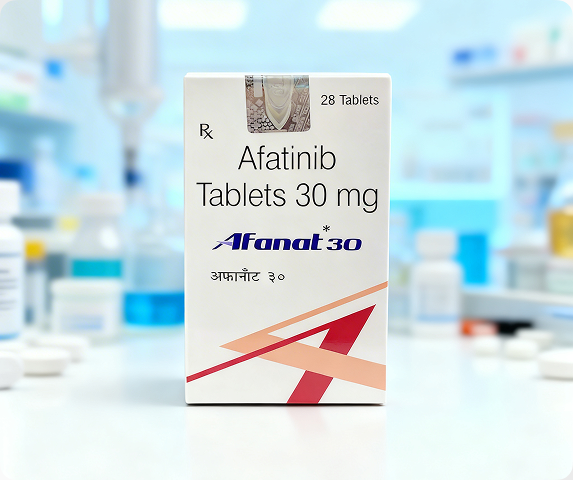
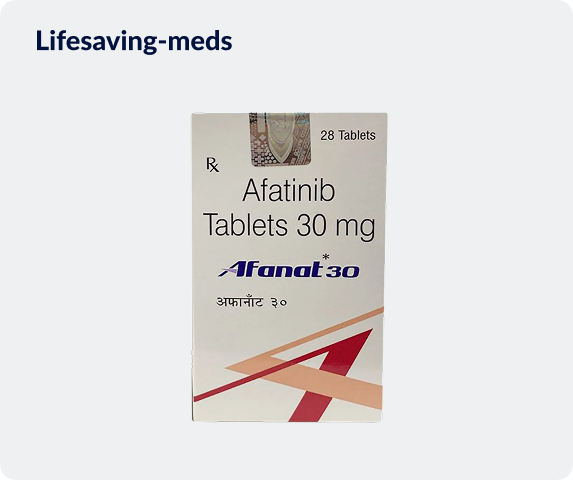
Afanat 30 mg Tablet is a high-quality product manufactured under strict quality control standards. Please consult with healthcare professional for specific information.
Non-small cell lung cancer (NSCLC) is a type of lung cancer that is caused by a mutation in the EGFR gene (a cell growth factor receptor, which controls cell division). This EGFR gene, when working excessively, constantly keeps the “cell growth” switched on. As a result, the tumor grows continuously, leading to life-threatening conditions. Afanat 30 mg works by blocking the EGFR gene and its receptors, which are responsible for uncontrolled cell division. This blocking is irreversible, thus halting any more growth of the tumor.
Squamous cell carcinoma of the lung is categorized as a subtype of NSCLC. This type of cancer is caused by the uncontrollable cell division of the flat squamous cells lining the respiratory tract. In advanced stages, the cancer can spread beyond the lungs despite the routine platinum-based chemotherapy. Afanat 30 mg works by blocking multiple ErbB receptors (molecular receptors involved in cell division), such as EGFR, HER2, and others. It inhibits the communication between cancer cells and growth signals, which prevents any further growth of the cancerous mass. Afanat 30 mg tablet is effective for this condition when routine chemotherapy is ineffective.
Afanat 30 mg tablet contains active ingredient Afatinib. helps to treat Non-Small Cell Lung Cancer with Epidermal Growth Factor Receptor mutation. Afanat 30 mg tablet works by inhibiting a specific family of proteins known as the ErbB receptor family, which includes EGFR (ErbB1), HER2 (ErbB2), and ErbB4. These receptors are present on normal cells, and they signal in favor of cell growth and proliferation. However, in malignant cells, the EGFR gene is mutated which causes these receptors to be expressed in an abnormally high number. As a result, the cell-division signal for the mutated cells remains continuously “switched on” and the cell proliferates rapidly and uncontrollably which leads to the formation of a cancerous mass.
Afanat blocks the ErbB family of proteins, specifically the tyrosine kinase domain on these protein receptors. Tyrosine kinase is a crucial enzyme important for cell signalling activities. By inhibiting this enzyme on the ErbB proteins, Afatinib is classified as an irreversible tyrosine kinase inhibitor (TKI). As the ErbB receptor expression is inhibited, several downstream pathways including MAPK and PI3K/AKT pathways involved in the signalling for cell division are also disrupted. This prevents malignant cells from proliferating any further.
As a result of the molecular interference by Afanat 30 mg, several changes in the tumor are observed including reduced tumor cell growth, inhibition of tumor progression, and increased apoptosis (programmed cancer cell death). As Afanat 30 mg tablet specifically works on the receptors that are only overexpressed in cancer cells,without affecting any normal body cells, it is considered as a targeted anticancer therapy. This property makes Afanat 20 mg a safer option than traditional chemotherapy.
In this way, Afanat 30 mg tablet helps in slowing down the progression of EGFR mutated lung cancer and enhances the control of the disease in patients suffering from advanced or metastatic disease.
Possible Side Effects of Afanat 30 mg tablet
– > Gastrointestinal
– > Skin / Appendages
– > General / Metabolic
– > Musculoskeletal
– > Hepatic / Laboratory
– > Hematologic
Afanat 30 mg must be consumed on an empty stomach, at least 1 hour before a meal or 2 hours after a meal.
On a molecular level, Afanat 30 mg starts acting immediately on the tumor cells. However, to observe noticeable changes in the body, it may take a few weeks.
Yes. Common skin problems associated with Afanat 30 mg are Skin rash, acne-like eruptions, dryness, and nail infections.
No. Afanat 30 mg is a target anticancer drug which specifically targets the malignant cells and not normal cells of the body.
No. This medication can affect the developing fetus and hence, it must not be consumed by pregnant women under any circumstances.

It is not recommended to take this medicine while breastfeeding.

It is unknown whether it is safe to drink alcohol while taking this medicine.
Inform your physician if you have any liver disorders before taking this medicine.
Inform your doctor about lung issues while on this medicine.

This medicine can cause tiredness. Avoid driving if you are unwell.

It is not recommended to take this medicine during pregnancy.

This medicine can be taken with food to reduce stomach irritation.

This medicine can be taken on an empty stomach for faster absorption.