Breast Feeding
DangerousIt is not recommended to take this medicine while breastfeeding.
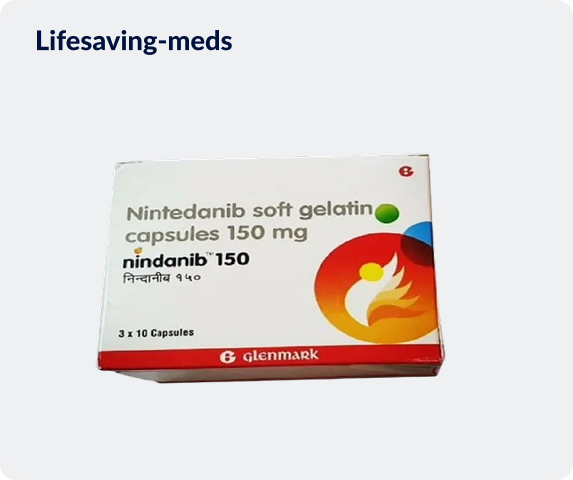
Nindanib 150 mg Capsule is a prescription medicine, belonging to the class of tyrosine kinase inhibitors, containing the active ingredient Nintedanib. It is used in the treatment of certain lung conditions and lung cancer. Nindanib 150 mg Capsule mainly controls the progression of these diseases and prevents them from worsening any further.
1. Idiopathic Pulmonary Fibrosis (IPF)
IPF refers to the chronic, progressive condition that affects the lung tissue, making it stiff and scarred. This interferes with the gaseous exchanges, which are important for respiration. Nindanib 150 mg Capsule is used for this condition as it can slow down the progression of the disease, reduce the lung scarring, and restore normal lung function.
2. Chronic Fibrosing Interstitial Lung Diseases
This condition consists of a group of diseases that cause long-term inflammation and fibrosis of the lung tissues. As a result, the lung flexibility decreases, which leads to difficulty in breathing. Nindanib 150 mg Capsule works by controlling the decline of lung function and maintaining overall respiratory ability.
3. Systemic Sclerosis-Associated Interstitial Lung Disease
This particular condition is a complication of Systemic Sclerosis, where the lung tissue becomes scarred and stiff. This is brought about by an autoimmune reaction and can be fatal. Nindanib 150 mg Capsule is administered to preserve the lung function and prevent it from worsening any further.
4. Non-Small Cell Lung Cancer (NSCLC)
NSCLC is caused by uncontrolled and abnormal cell division in the lung tissue. This interferes with lung function and can even be fatal. This leads to symptoms like persistent cough, chest pain, and weight loss. Nindanib 150 mg Capsule works by slowing down the tumor progression and can aid the chemotherapy treatments.
The dosing guidelines of Nindanib 150 mg Capsule for non-cancer diseases are the same for all the non-cancer indications. The dosing guidelines are explained below:
Standard Dosing
This dosing is prescribed for the following indications:
1. Idiopathic Pulmonary Fibrosis (IPF)
2. Chronic Fibrosing Interstitial Lung Diseases
3. Systemic Sclerosis-Associated Interstitial Lung Disease
You can buy Nindanib 150 mg Capsule from Lifesaving-meds.com at low price online with free shipping & free sample medicines. Lifesaving-meds.com provide Nindanib 150 mg at very less wholesale price for sale from India with low price guarantee, big discounts, free delivery, credit card / debit card, Zellepay, paypal, crypto / Bitcoin payment option & more in the United states of America (USA) – New York, California, Texas, Florida, Ohio, Oregon, Georgia, Denver, Illinois, Oregon, Pennsylvania, Washington, Wyoming & more; United Kingdom (UK) – London, Birmingham, Wales, Manchester & more; Europe (EU) – Moscow (Russia), Paris (France), Spain & more; and Australia (AU) – Sydney, Melbourne, Brisbane & more. So, buy Nindanib 150 mg Capsule near you when you are prescribed with this medication or search as Nindanib 150 mg for sale near me on google, bing, yahoo, duckducko, AOL & anywhere.
Nindanib 150 mg Capsule is a tyrosine kinase inhibitor that contains an active ingredient called Nintedanib. Nindanib 150 mg Capsule targets the pathways that lead to fibrosis and pathologically growing tissue. It is commonly used for the treatment of conditions like Idiopathic Pulmonary Fibrosis and Non-Small Cell Lung Cancer, both of which have the potential to damage the normal tissue of the lungs due to excessive scarring or uncontrolled cell growth.
In fibrotic lung disorder, the fundamental problem is the natural repair mechanism of the body. After an injury occurs to lung tissue, the tissues release signals (growth factors) to repair the injury. However, in the case of Fibrosis, the repair mechanism becomes abnormally and disproportionately stimulated. As a result, fibroblasts (the cells that create connective tissue) divide uncontrollably or proliferate excessively and secrete large amounts of collagen (the non-elastic structural protein). This leads to thickening, scarring, and loss of elasticity of the lung tissue. As a result, the lungs can no longer expand enough to carry out the natural “balloon-like” movement, which is important for breathing.
Nindanib 150 mg Capsule works by blocking the action of receptor tyrosine kinases that are responsible for receiving and transferring the growth factors, e.g., VEGF, PDGF, and FGF into the cell, via a signalling pathway By blocking the action of these receptor tyrosine kinases, Nintedanib inhibits the signaling pathways responsible for the activation, proliferation, and migration of fibroblasts, resulting in the inhibition of the stimulation of fibrosis.
Nindanib 150 mg Capsule slows the rate of scar tissue formation in the lungs, which helps maintain lung structure and function long term. Nindanib 150 mg Capsule has both antifibrotic and anti-angiogenic properties. It prevents the formation of new blood vessels, which is critical in cancers like non-small cell lung cancer (NSCLC). These blood vessels are essential for tumors for a constant supply of blood and oxygen. It also inhibits the VEGF receptors, allowing Nintedanib to decrease the blood vessel development within the tumor, thus limiting its supply of oxygen and nutrients. In this way, Nindanib 150 mg Capsule slows down the progression of the disease, enhancing the effect of chemotherapy when used together. Therefore, these molecular changes have broader physiological effects, leading to a slower progression of disease.
For fibrotic diseases, Nindanib 150 mg Capsule facilitates a decrease in lung capacity and slows down the deterioration in breathlessness. For cancer, this medication prevents the tumor from growing any further. Thus, Nindanib 150 mg Capsule works on key disease pathways, such as reducing abnormal tissue scarring and limiting tumor growth, ultimately preserving the function of organs and improving clinical outcomes.
1.Common Side Effects (Very Frequently Seen)
2. Gastrointestinal Side Effects
3. Liver-Related Side Effects (Important)
4. Cardiovascular Side Effects
5. Bleeding & Blood Disorders
6. Kidney & Urinary Effects
8. Nervous System Effects
10. Musculoskeletal Effects
11. Endocrine & Metabolic Effects
12. General / Systemic Effects
13. Serious / Rare but Dangerous Effects
Key Side Effects Patients Should Watch For
Nindanib 150 mg Capsule must only be consumed when prescribed by a healthcare provider.
1.What are the uses of Nindanib 150 mg Capsule?
Nindanib 150 mg Capsule is used to treat certain lung conditions and Non-Small Cell Lung Cancer.
2.Does Nindanib 150 mg Capsule cure fibrosis?
No. Nindanib 150 mg Capsule cannot completely cure fibrosis, and can only slow down the progression of the disease.
3.Can Nindanib 150 mg Capsule be taken on an empty stomach?
Nindanib 150 mg Capsule must only be consumed with meals to avoid gastrointestinal side effects.
4.What are the most common side effects?
Common side effects of Nindanib 150 mg Capsule include diarrhea, nausea, vomiting, and loss of appetite.
5.Can Nindanib 150 mg Capsule be taken by pregnant or breastfeeding women?
No. Nindanib 150 mg Capsule must not be consumed by pregnant or breastfeeding women.

It is not recommended to take this medicine while breastfeeding.

It is unknown whether it is safe to drink alcohol while taking this medicine.
Inform your physician if you have any liver disorders before taking this medicine.
Inform your doctor about lung issues while on this medicine.

This medicine can cause tiredness. Avoid driving if you are unwell.

It is not recommended to take this medicine during pregnancy.

This medicine can be taken with food to reduce stomach irritation.

This medicine can be taken on an empty stomach for faster absorption.